

Residents from Port Sheldon, Crockery and Spring Lake townships came to a two-hour Ottawa County commission work session on Sept. 18 with one question: who is watching the cars that pass the county's license plate cameras? Sheriff Eric DeBoer answered with a written report laying out how the system works.
The debate started at the Aug. 25 commission meeting, when residents used public comment to raise privacy concerns about the cameras, made by the company Flock Safety. Commissioners now want future contract renewals, funding and the surveillance policy to come back to the full board for a vote, Ottawa News Network reported. The contract has renewed automatically since the board ratified it in April 2024.
Residents worried about mass surveillance of drivers who have done nothing wrong, tracking without a warrant, misuse by officers, and who owns the data and which other agencies can reach it. At the September session, they pressed commissioners on how a record of where ordinary people drive could be searched and shared.
How the system works
The sheriff's report lays out the rules:
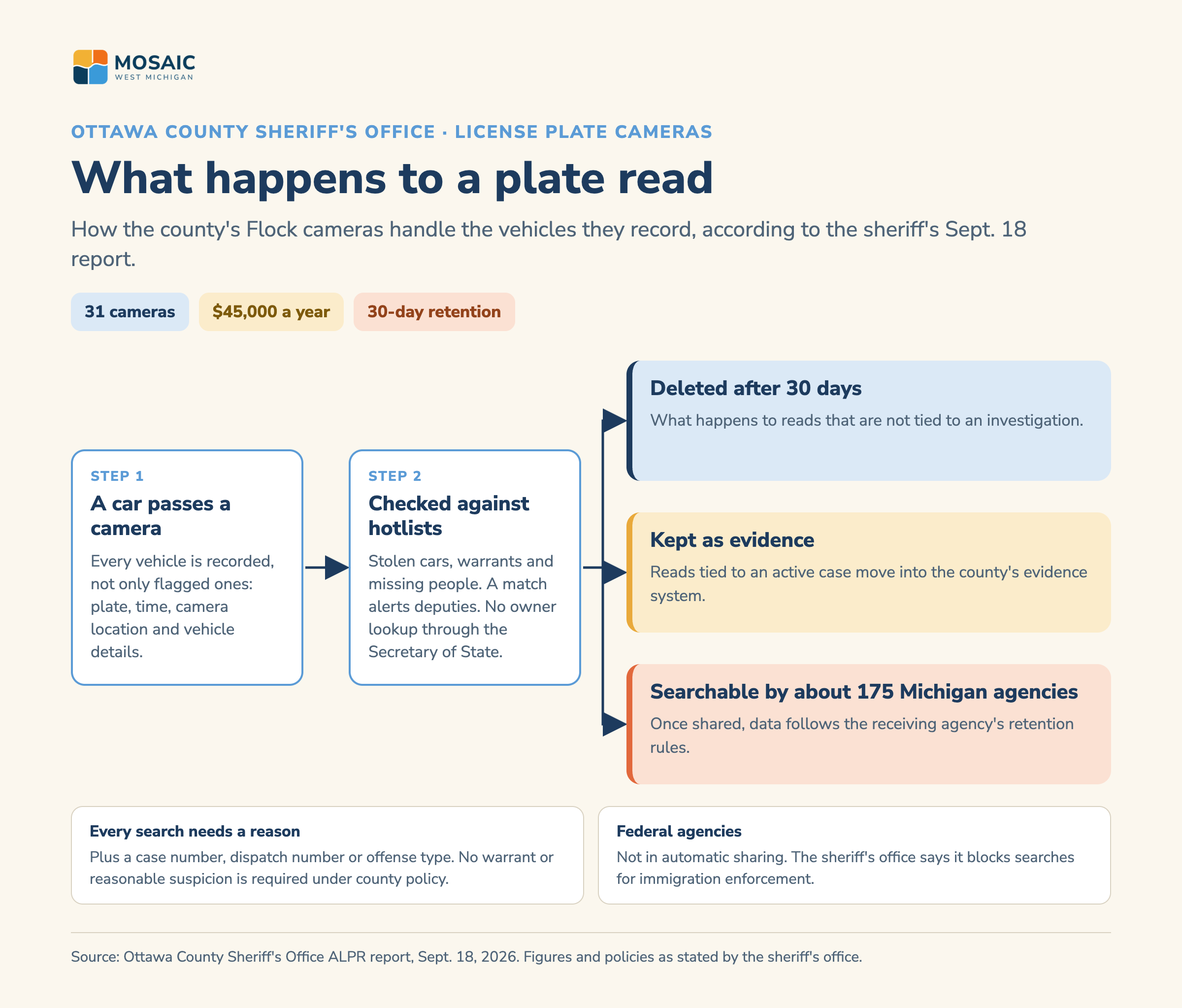
- The county runs 31 cameras: 15 it pays for, 2 mobile units, and 14 added by townships and cities that reimburse the county.
- The county pays $45,000 a year, or $3,000 per camera, from county funds.
- Cameras record every vehicle that passes, not only flagged ones, logging the plate, time, camera location and vehicle details. Plates are checked against police hotlists for stolen cars, warrants and missing people. The system does not look up owners through the Secretary of State.
- Images are deleted automatically after 30 days unless they become evidence in a case. Data shared with another agency falls under that agency's retention rules.
- A deputy does not need reasonable suspicion or a warrant to search the data, but every search requires a stated reason and a case number, dispatch number or offense type.
- About 175 Michigan police agencies can search the county's data automatically. The sheriff's office says federal agencies are excluded from automatic sharing and that it blocks searches for immigration enforcement.
From February 2024 through Sept. 8, the sheriff's office credits the cameras with 131 arrests, $917,250 in recovered property, 72 recovered stolen vehicles and 15 missing people located.
The wider fight
The city of Holland runs its own 21 Flock cameras, installed in 2022, and its council heard a presentation on them at a Sept. 9 study session. Elsewhere in Michigan, South Lyon voted 5-2 on Sept. 28 to end its Flock contract, joining Ferndale, Westland and others.
Six or seven of the county's cameras have been damaged this year, and a 19-year-old Holland man faces the county's first felony charge for destroying one.
Michigan has no state law on how long police may keep this data. House Bill 5493 would cap it at 14 days and require quarterly public reports. It is before the House Judiciary Committee. DeBoer has asked commissioners to push for a law making misuse of the data a crime.
The sheriff's office publishes a Flock transparency portal listing its cameras, plate reads, searches, policies and retention rules. Residents with questions can call the sheriff's office at 616-738-4000.


